Why MRI Valuations

Independent machinery and equipment appraisal services built for serious decisions.

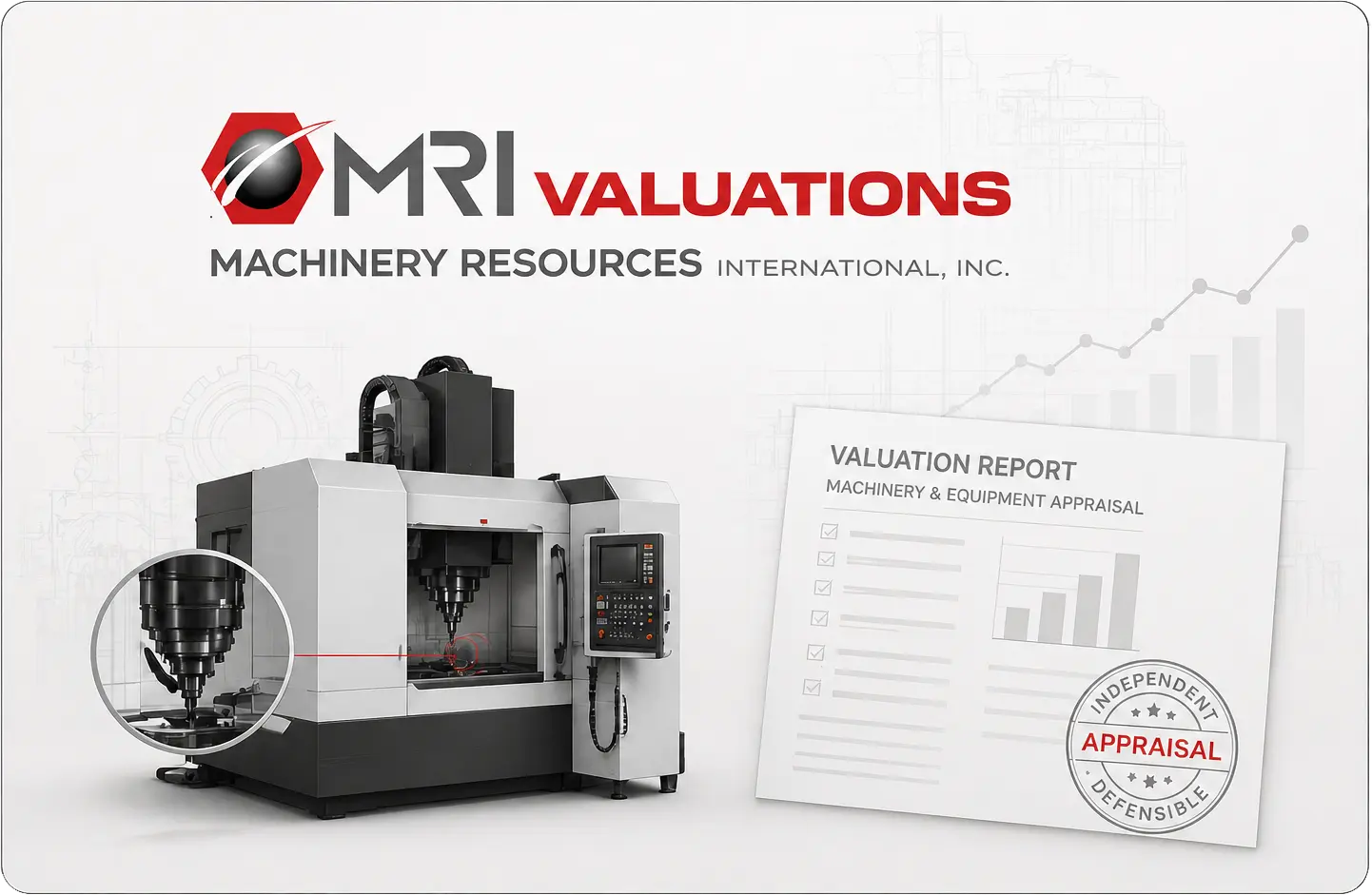
MRI Valuations provides machinery and equipment appraisal reports for financing, acquisitions, legal matters, tax planning, insurance, liquidation, and other assignments where defensible value matters.

From single assets to full facilities, the focus is simple: match the scope to the assignment, keep the process clear, and deliver reporting that holds up under scrutiny.

What clients rely on

  • Scope matched to the assignment
  • Clear reporting designed for real financing, legal, and tax use
  • Responsive communication from start to finish
  • Coverage across industrial and commercial asset classes
25+ years of experience National coverage Field & desktop reports AMEA / USPAP aligned
Request an appraisal

Tell us about your equipment.

Send a few details about your assignment and MRI Valuations will help determine the right scope, timing, and next steps.

Common assignments

Situations where clear value matters most.

Financing & asset based lending

Support collateral review, refinancing, lending decisions, and other situations where dependable machinery and equipment values matter.

Transactions, disputes & planning

Use independent appraisal support for acquisitions, buyouts, partner changes, litigation, arbitration, and estate planning.

Insurance, tax & liquidation

Establish supportable values for insurance needs, ad valorem tax matters, orderly liquidation, and forced liquidation scenarios.

Report scope

Choose the right level of reporting.

Not every assignment needs the same level of inspection and documentation. MRI helps determine the right report type based on the intended use, timing, and level of support required.

Field appraisal report

Best when condition, configuration, and documentation matter most. Includes an on-site inspection and is typically the right fit for higher-stakes assignments.

Desktop appraisal report

Best when a more efficient opinion of value is needed without an on-site inspection. Based on photos and equipment details provided by the client.

Basis of value

The valuation basis should match the assignment.

Different situations call for different standards of value. These are the most common definitions used in machinery and equipment appraisal work.

Forced Liquidation Value
Forced liquidation value is the value realized when assets are sold piecemeal, under duress at public auction. Forced liquidation value assumes that the buyer is responsible for all costs of removal and is purchasing the assets “as is, where is” with no warranties or representations as to the condition of the assets being made by the seller. It is further assumed that the assets are properly advertised in a manner considered to be commercially reasonable.
Orderly Liquidation Value
Orderly liquidation value is the value realized when assets are sold piecemeal, through negotiation, over a predetermined period of time, often three to six months. Orderly liquidation value assumes that the buyer is responsible for all removal costs and is purchasing the assets “as is, where is” with no warranties or representations as to the condition of the assets being made by the seller. It is further assumed that the assets are properly advertised in a manner considered to be commercially reasonable. Buyer and seller further acknowledge that if an acceptable price cannot be negotiated within the time period specified, the final option would be to offer the assets for sale at public auction.
Market Value
Market value is defined as the price, expressed in terms of cash or cash equivalents, at which asset(s) will change hands between a willing and able buyer and seller. It is assumed that both the buyer and seller are acting at arm’s length in an open and unrestricted market. Furthermore, neither buyer nor seller is under compulsion to buy or sell and both have reasonable knowledge of the relevant facts.
Orderly Liquidation Value In Place

Orderly liquidation value in place is the price that a knowledgeable buyer would have to pay a knowledgeable seller who is under duress, for asset(s) being purchased in place to remain in operation in “as is” condition, taking advantage of all leasehold and site improvements designed to facilitate its/their operation.

An evaluation of this type does not take into consideration the past, present, or forecasted income-generating performance of the company or the income-generating performance of any of the products produced by the company, nor does the evaluation consider whether the business generates sufficient income to support the values concluded. It is, however, assumed that all specially designed and built asset(s) will continue to be used in the manner for which it/they was/were originally intended.

The orderly liquidation value in place definition assumes an adequate period of time to properly advertise the asset(s) in a manner that is commercially reasonable. However, it is clearly understood by both the buyer and seller that the sale of the asset(s) is under duress, and that the marketing time is limited to a predetermined period of time, often between six and 12 months.


Market Value In Place

Market value in place is the price at which asset(s) would change hands between a willing and able buyer and seller, with neither under compulsion to buy or sell, with both having full knowledge of the relevant facts. The asset(s) is/are being purchased to remain in place to remain in operation, taking advantage of all leasehold and site improvements designed to facilitate its/their operation, with the seller accurately and completely representing the existing condition and operability of the asset(s) to the buyer.

A market value in place appraisal does not take into consideration the past, present, or forecasted income-generating performance of the company or the past, present, or forecasted income-generating performance of any of the products produced by the company. Furthermore, an evaluation of this type does not consider whether the business generates sufficient income to support the values concluded. However, it is assumed that all specially designed and built asset(s) will continue to be used in the manner for which it/they was/were originally intended.

Replacement Cost
Replacement cost is the current cost of a similar new asset(s) having the nearest equivalent utility to the asset(s) being valued. Furthermore, replacement cost analysis takes into consideration the transportation and installation costs required to facilitate normal operation.
Coverage

Broad equipment coverage across major industries.

MRI Valuations works across a wide range of industrial, commercial, and technical asset categories, allowing clients to handle diverse assignments with one experienced team.

Metalworking Heavy Construction Food Processing Industrial Manufacturing Medical Woodworking Laboratory & Scientific Material Handling Chemical, Plastic & Rubber High Tech Network & Computer Biotech
Standards

Professional standards that reinforce credibility.

MRI Valuations' work is supervised by professionals aligned with recognized machinery and equipment appraisal standards, including AMEA and USPAP.

Helpful details to include in your message

  • Equipment type and approximate quantity
  • Asset location
  • Purpose of the appraisal
  • Any timing or deadline requirements
Contact MRI Valuations

Need a machinery or equipment appraisal?

Contact MRI Valuations to discuss your assignment, timeline, and reporting needs. We can help determine the right scope and next steps for your appraisal.